
The whole truth about 6G, 5G and 4G LTE networks
The whole truth about 6G, 5G and 4G LTE networks
- Different generations of mobile networks.
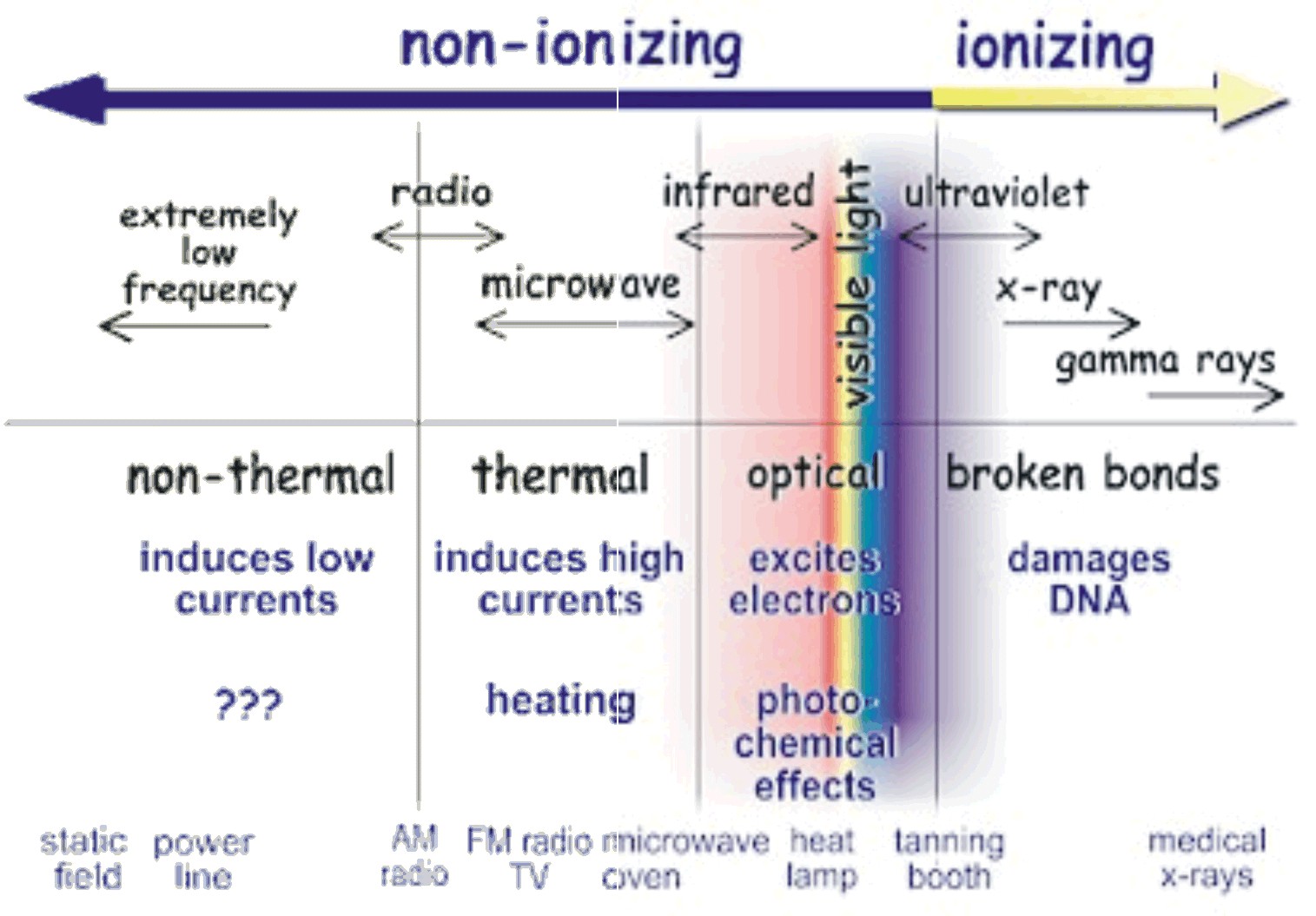
Before going into detail about the different mobile networks, it must be remembered that there are two types of electromagnetic radiation, on the one hand, there are ionizing type radiation, which have a very small wavelength and are present in things like ultraviolet light or x-rays, these are very high frequency, they have the power to pull electrons from atoms and are potentially dangerous if they are not used under the corresponding safety measures; on the other hand, non-ionizing radiation is found, which is present in the telecommunications spectrum or in visible light, unlike ionizing radiation, it is totally safe for health (Instituto de Salud Pública de Chile, n.d.; Nocetti, 2019).
The networks used in telecommunications, whether for radio or TV signals, internet or telephony, belong to the group of non-ionizing radiation, this means that they are completely safe. As for mobile telephony, the first networks that existed were the first generation or 1G, these worked through cells and there was no standardization yet, from this first generation comes the cellular name and its capacity to transmit data was around 1kbps (kilobits per second). This service appeared in the 1980s, it is analog technology and reached nearly 20 million users in 1990 (MÁSMÓVIL, n.d.).
The standardization of mobile phone networks came in the early 1990s with GSM (Global System for Mobile) technology, also known as 2G, which works at a speed between 56kbps and 114kbps, this brought novelties such as text messages SMS and better audio quality than 1G connection. GPRS (General Packet Radio Service) and EGPRS (Enhanced General Packet Radio Service) technologies appear with this generation as an improvement to GSM and give the possibility of surfing the Internet and exchanging images via MMS multimedia messages (Blasco, 2016).
3G networks appear in 2001, this technology integrates better with the internet and provides services such as program downloads and instant messaging (Okdiario, 2018) and has a speed of up to 2 Mbps (Megabit per second), its well-known evolution Like 3.5G, HSDPA, H, H + (High Speed Downlink Packet Access) it can reach a speed of 14 Mbps.
4G networks appear in 2010, it is the successor to the 3G network and reaches an expected speed of up to 1 Gbps (Gigabit per second). Among the new services it brings are high-definition video calls, geolocation, streaming and online video games. The 4G LTE (Long Term Evolution) network is a standard for the 4G network that, unlike previous evolutions, provides a slower connection, since it is in charge of the speed standards ITU-R (International Telecommunication Union Radiocummunication sector), realized that providers were far from being able to deliver the expected speed of a true 4G network (Rebolledo, 2016).
The 5G network, natural evolution of the 4G network, promises a connection speed of up to 20 GBps (GigaBytes per second), this appears in the year 2020, it has been controversial mainly due to disinformation, fear of new technologies and appearance of different myths without any foundation (Jiménez, 2018). Among the improvements that the 5G network promises are the reduction of latency, this means that it will be able to connect faster than its predecessors. This network is not harmful, since it remains within the spectrum of non-ionizing radiation just like any radio wave (IEEE, 2005; MINSAL, 1999).
It is normal for technologies to be invented for many years and even decades before being commercialized to the general public, and this is the case with 6G. The sixth generation, a natural evolution of 5G, in 2020 is already under investigation and we have to wait for the ITU-R to define its standards before being released to the public. According to some predictions (Paredes, 2020), it is expected that its maximum speed will reach 100 Gbps and that it will appear massively by 2030.

References
Blasco, L. (2016). “Cuáles son las diferencias entre E, GPRS, 3G, 4G, 5G y esas otras redes a las que se conecta tu celular (y cómo te afectan tu conexión a internet)”. In BBC Mundo. Retrieved from https://www.bbc.com/mundo/noticias-37247130
IEEE. (2005). IEEE standard for safety levels with respect to human exposure to radio frequency electromagnetic fields, 3 kHz to 300 GHz. IEEE Std C95.1
Instituto de Salud Pública de Chile. (n.d.). Sección Radiaciones Ionizantes y No Ionizantes. Retrieved from http://www.ispch.cl/saludocupacional/subdepto_ambientes_laborales/secciones/radiaciones
Jiménez, J. (2018). El 5G es el nuevo Chemtrail: cómo los miedos de la sociedad vuelven una y otra vez con nuevos chivos expiatorios. Retrieved from https://www.xataka.com/medicina-y-salud/5g-nuevo-chemtrail-como-miedos-sociedad-vuelven-otra-vez-nuevos-chivos-expiatorios
MÁSMÓVIL. (n.d.). La Evolución de la tecnología móvil: 1G, 2G, 3G, 4G… Retrieved from https://blog.masmovil.es/la-evolucion-de-la-tecnologia-movil-1g-2g-3g-4g/
MINSAL. (1999). Reglamento sobre Condiciones Sanitarias y Ambientales básicas en los lugares de trabajo D.S. 594/99.
Nocetti, F.A. (2019). “Radiación ionizante y no ionizante”. In NabbuBlog. Retrieved from http://nabbublog.blogspot.com/2019/01/radiacion-ionizante-y-no-ionizante.html
Okdiario. (2018). ¿Qué significa el 1G, 2G, 3G, 4G y 5G? Retrieved from https://okdiario.com/curiosidades/que-significa-1g-2g-3g-4g-5g-3223153
Paredes, L.M. (2020). "¿Qué es el 6G? Todo lo que debes saber sobre esta red del futuro". In Digital Trends en Español. Retrieved from https://es.digitaltrends.com/celular/que-es-la-red-6g/
Rebolledo, R.A. (2016). “¿Cuál es la diferencia entre el 4G y el 4G LTE?”. In El Economista. Retrieved from https://www.eleconomista.com.mx/tecnologia/Cual-es-la-diferencia-entre-el-4G-y-el-4G-LTE-20160908-0105.html
How to cite this article
Nocetti, F.A. (2020). "The whole truth about 6G, 5G and 4G LTE networks". In NabbuBlog. Retrieved from http://nabbublog.blogspot.com/2020/06/the-whole-truth-about-6g-5g-and-4g-lte.html