
Asteroides, cometas, meteoritos y meteoroides / Asteroids, comets, meteorites, and meteoroids
Asteroids, comets, meteorites, and meteoroids
- Pequeños objetos que existen en el espacio
- Small objects that exist in space
Los dos cuerpos principales, son el asteroide, que es un cuerpo rocoso relativamente pequeño y gira alrededor del sol, el otro es el cometa, que está constituido por hielo y rocas, este es característico porque tiene una cola de polvo y gas que se forma al ser vaporizados por el sol el hielo y las rocas que lo componen (RPP Noticias, 2013). La gran diferencia entre los asteroides y los cometas es su composición, mientras que los asteroides son un cuerpo rocoso, que puede ser carbonáceo o metálico, los cometas son de roca y hielo.
En el sistema solar, la órbita de los asteroides suele encontrarse entre la de sol y Neptuno, normalmente oscilan entre Marte y Júpiter, como los cuerpos del cinturón de asteroides, aunque a veces, su órbita puede cambiar al cruzarse con un planeta de tamaño mayor, como los asteroides troyanos que se mueven en torno a Júpiter. Los que son cercanos a la tierra se clasifican como NEO o Near-Earth Object y los que están fuera del sistema solar como centauros (National Geographic, s.f.).
Un meteoroide es una partícula proveniente de un cometa o de un asteroide, esta suele medir entre 100 micrómetros y 50 metros de diámetro, también gira alrededor del sol y pasa a denominarse meteoro cuando atraviesa la atmósfera del planeta Tierra, se caracteriza por su fenómeno lumínico, también conocido como estrella fugaz. Si el meteoro no se evapora en la atmósfera y choca con la superficie de la tierra, pasa a llamarse meteorito (Te Interesa, 2013).
Esta imagen compuesta muestra los tamaños comparativos de ocho asteroides.
This composite image shows the comparative sizes of eight asteroids.

NASA/JPL-Caltech/JAXA/ESA / Public domain
Cometa Hartley
Comet Hartley
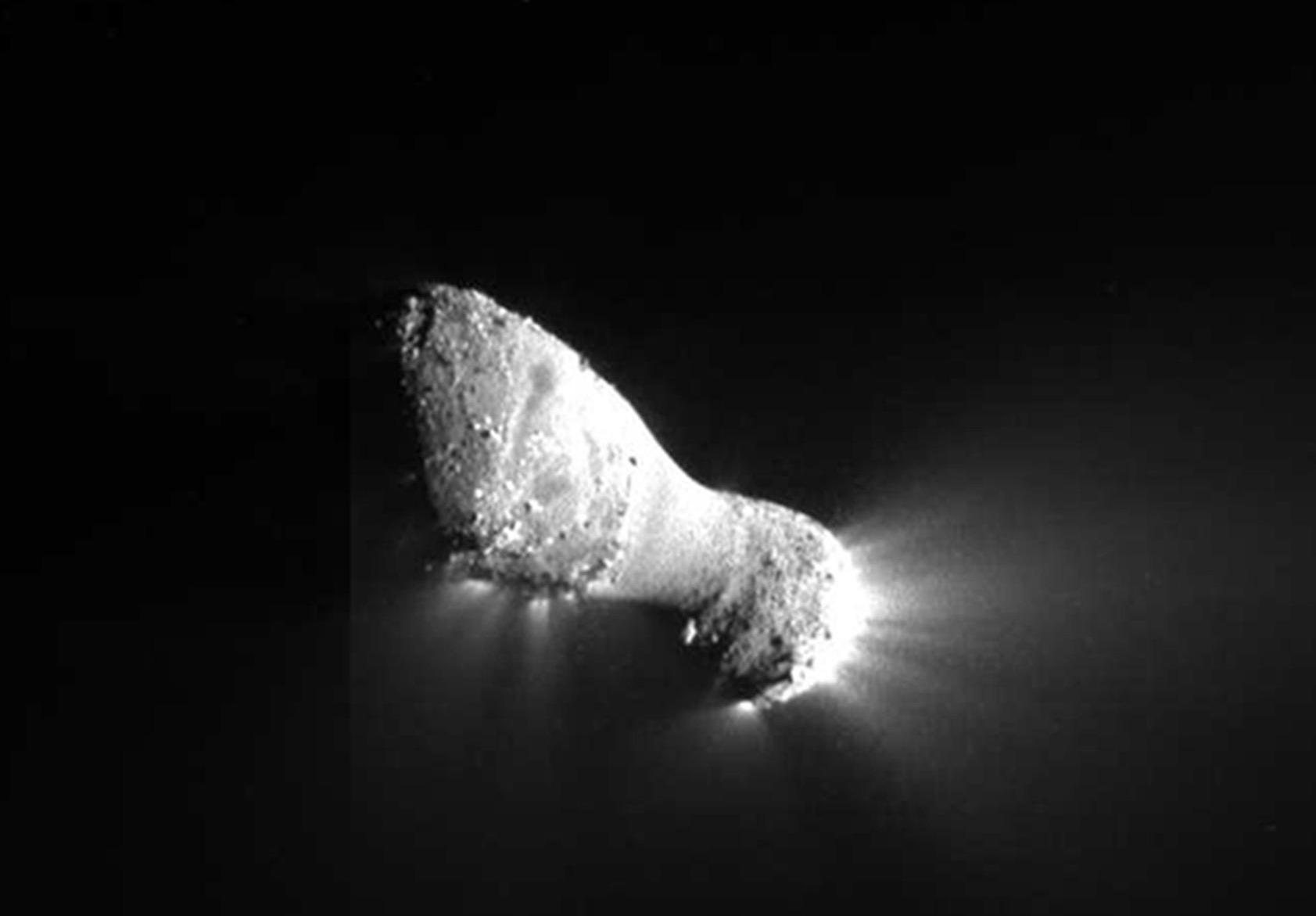
NASA/JPL-Caltech/UMD / Public domain
Cometa Hale-Bopp
Comet Hale-Bopp

Philipp Salzgeber / CC BY-SA 2.0 AT
There are many objects in space, from small microscopic stones, to large stars and galaxies. Among the most common objects are asteroids, comets, meteorites, and meteoroids, space bodies that, although they can sometimes be treated as the same object, have some differences.
The two main bodies are the asteroid, which is a relatively small rocky body and revolves around the sun, the other is the comet, which is made up of ice and rocks, this is characteristic because it has a tail of dust and gas that forms as the ice and the rocks that compose it are vaporized by the sun (RPP Noticias, 2013). The big difference between asteroids and comets is their composition, while asteroids are a rocky body, which can be carbonaceous or metallic, comets are rock and ice.
In the solar system, the orbit of asteroids is usually between that of the Sun and Neptune, they normally oscillate between Mars and Jupiter, like the bodies of the asteroid belt, although sometimes, their orbit can change when crossing a larger planet , like the Trojan asteroids that move around Jupiter. Those that are close to the earth are classified as NEO or Near-Earth Object and those that are outside the solar system as centaurs (National Geographic, n.d.).
A meteoroid is a particle from a comet or an asteroid, it usually measures between 100 micrometers and 50 meters in diameter, it also revolves around the sun and is called a meteor when it passes through the atmosphere of planet Earth, it is characterized by its light phenomenon , also known as a shooting star. If the meteor does not evaporate in the atmosphere and collide with the earth's surface, it is renamed a meteorite (Te Interesa, 2013).
The two main bodies are the asteroid, which is a relatively small rocky body and revolves around the sun, the other is the comet, which is made up of ice and rocks, this is characteristic because it has a tail of dust and gas that forms as the ice and the rocks that compose it are vaporized by the sun (RPP Noticias, 2013). The big difference between asteroids and comets is their composition, while asteroids are a rocky body, which can be carbonaceous or metallic, comets are rock and ice.
In the solar system, the orbit of asteroids is usually between that of the Sun and Neptune, they normally oscillate between Mars and Jupiter, like the bodies of the asteroid belt, although sometimes, their orbit can change when crossing a larger planet , like the Trojan asteroids that move around Jupiter. Those that are close to the earth are classified as NEO or Near-Earth Object and those that are outside the solar system as centaurs (National Geographic, n.d.).
A meteoroid is a particle from a comet or an asteroid, it usually measures between 100 micrometers and 50 meters in diameter, it also revolves around the sun and is called a meteor when it passes through the atmosphere of planet Earth, it is characterized by its light phenomenon , also known as a shooting star. If the meteor does not evaporate in the atmosphere and collide with the earth's surface, it is renamed a meteorite (Te Interesa, 2013).
Referencias / References:
National Geographic. (s.f.). ¿Diferencias un meteorito y un asteroide?. Recuperado de https://www.nationalgeographic.es/espacio/diferencias-un-meteorito-y-un-asteroide
RPP Noticias. (2013). Conozca las diferencias entre asteroides, cometas y meteoritos. Recuperado de https://rpp.pe/tecnologia/mas-tecnologia/conozca-las-diferencias-entre-asteroides-cometas-y-meteoritos-noticia-567518
Te Interesa. (2013). No confunda 'Asteroide' con 'Meteorito'...¡No es lo mismo!. Recuperado de http://www.teinteresa.es/ciencia/confunda-Asteroide-MeteoritoNo-mismo_0_866315400.html
RPP Noticias. (2013). Conozca las diferencias entre asteroides, cometas y meteoritos. Recuperado de https://rpp.pe/tecnologia/mas-tecnologia/conozca-las-diferencias-entre-asteroides-cometas-y-meteoritos-noticia-567518
Te Interesa. (2013). No confunda 'Asteroide' con 'Meteorito'...¡No es lo mismo!. Recuperado de http://www.teinteresa.es/ciencia/confunda-Asteroide-MeteoritoNo-mismo_0_866315400.html
Cómo citar este artículo:
Nocetti, F.A. (2020). "Asteroides,
cometas, meteoritos y meteoroides". En NabbuBlog. Recuperado de http://nabbublog.blogspot.com/2020/03/asteroides-cometas-meteoritos-y.html
How to cite this article:
Nocetti, F.A. (2020). "Asteroids, comets, meteorites, and meteoroids". In NabbuBlog. Retrieved from http://nabbublog.blogspot.com/2020/03/asteroides-cometas-meteoritos-y.html