
The Nazca lines
The Nazca lines
- Giant geoglyphs seen from above
These geoglyphs, found in the Nazca desert, Peru, were created by the Nazca culture, which inhabited the place between the years 200 BC. and 600 A.D. These figures that represent animals, creatures and plants, can only be seen from the height, either, by flying over the area or by observing from the nearby hills (Hablemos de Culturas, 2017; Ayuso, 2015). These lines, were originally discovered in 1927 by the archaeologist Toribio Mejía Xesspe almost by chance, since, when touring the mountains near the area, he could see these figures from the heights, although between 2016 and 2018, through the research led by Masato Sakai and through artificial intelligence, 142 new figures were discovered, including fish, llamas, monkeys and birds. There have been many speculations about what they represent, the hypotheses speak from centers of religious activity to astronomical calendars, it is also believed that, due to the characteristics of these figures, they may have been created by the Nazca culture in conjunction with the Tiahuanaco, Paracas and Mochica cultures. These images were formed by removing the red stones that were on the surface, thus leaving the white sandstone in sight and the figures were formed with measures ranging from 27 meters to the whale and between 259 to 275 meters to the birds, it is also known, that are interconnected with each other, through spiral lines. The Nazca lines are found both on the flat part of the desert, and on the slopes, although the latter are not as defined, since some of their parts have been erased by the action of the rocks that fall from the mountains. For the study of these geoglyphs, they are usually divided into two groups: group A which are the largest and measure more 50 meters each, it is estimated that they should be the most recent and that their origin should be between the years 100 and 300 AD, while Group B is made up of figures less than 50 meters and was built around 100 BC or earlier. In 1993, the location of these figures was converted into an archaeological reserve and the geoglyphs became part of the Cultural Heritage of the Nation of Peru and in 1994, they were named world heritage by Unesco (BBC News Mundo, 2019), although unfortunately, they have been partially damaged by some natural problems, such as sandstorms and others of human origin, such as the construction of the Pan-American highway.
The monkey
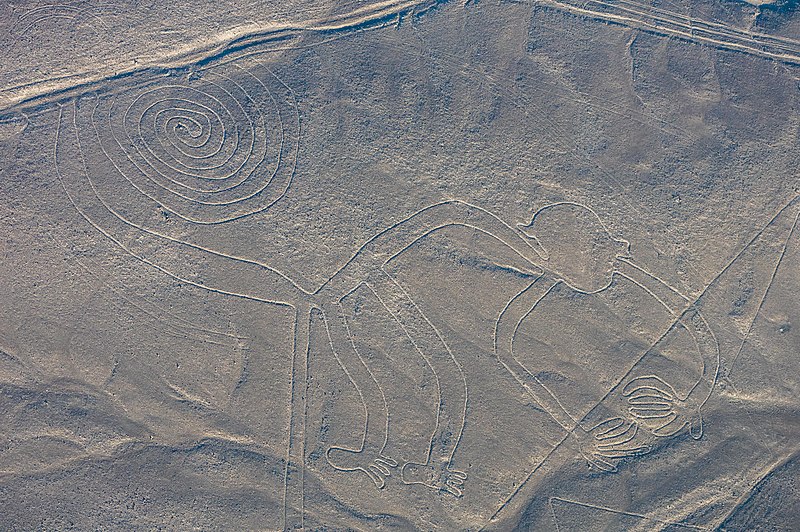
Diego Delso [CC BY-SA 4.0 (https://creativecommons.org/licenses/by-sa/4.0)]
The spider
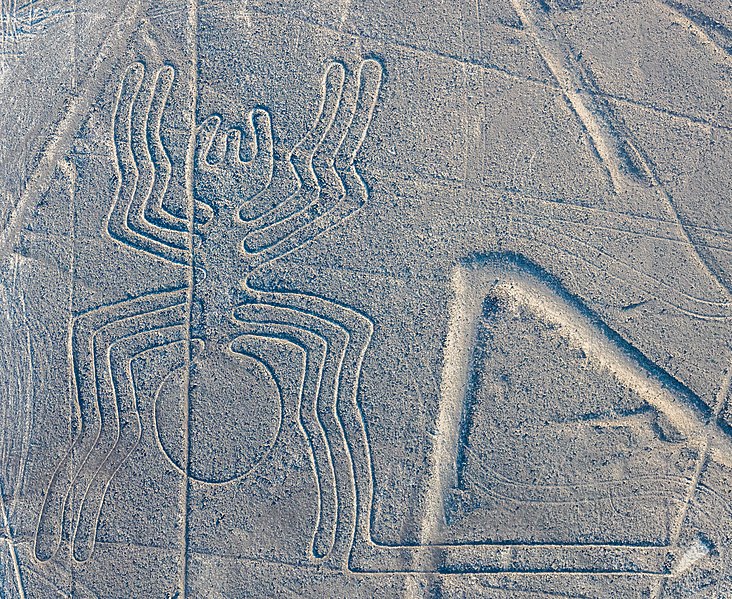
Diego Delso [CC BY-SA 4.0 (https://creativecommons.org/licenses/by-sa/4.0)]
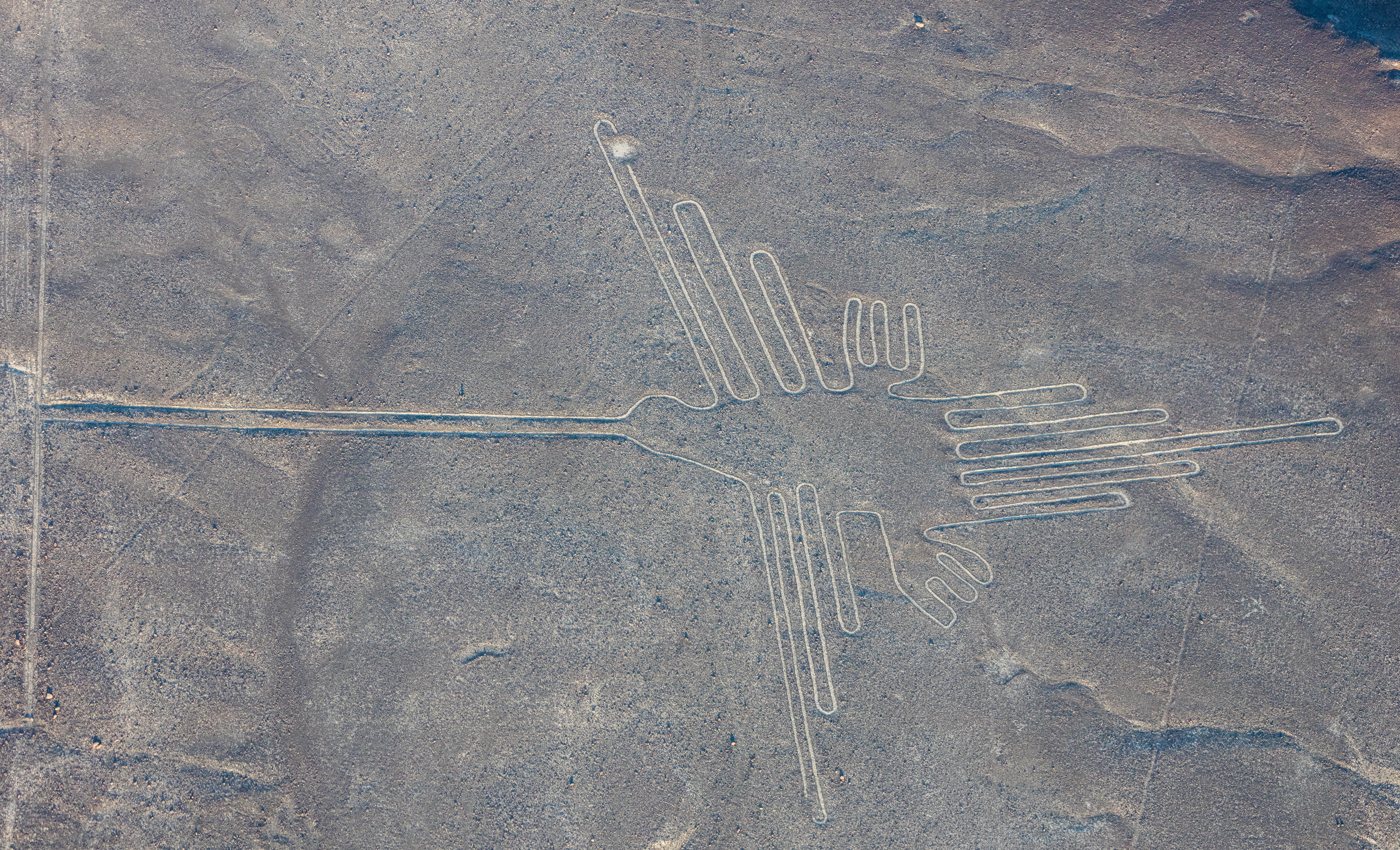

Diego Delso [CC BY-SA 4.0 (https://creativecommons.org/licenses/by-sa/4.0)]
The whale

Diego Delso [CC BY-SA 4.0 (https://creativecommons.org/licenses/by-sa/4.0)]
Geometric shapes

Diego Delso [CC BY-SA 4.0 (https://creativecommons.org/licenses/by-sa/4.0)]
The giant (also known as owl-man)

Diego Delso [CC BY-SA 4.0 (https://creativecommons.org/licenses/by-sa/4.0)]
New shapes

Fedez2420 [CC BY-SA 4.0 (https://creativecommons.org/licenses/by-sa/4.0)]
References:
Ayuso, M. (2015). “El misterio de las líneas de Nazca, resuelto por los arqueólogos”. En El Confidencial. Recuperado de https://www.elconfidencial.com/alma-corazon-vida/2015-05-07/el-misterio-de-las-lineas-de-nazca-resuelto_789817/
BBC News Mundo. (2019). Líneas de Nazca en Perú: así son los intrigantes nuevos geoglifos descubiertos con tecnología de última generación. Recuperado de https://www.bbc.com/mundo/noticias-america-latina-50467520
Hablemos de Culturas. (2017). Figuras de Nazca: todo lo que no sabías de ellas. Recuperado de https://hablemosdeculturas.com/figuras-de-nazca/
Hablemos de Culturas. (2017). Figuras de Nazca: todo lo que no sabías de ellas. Recuperado de https://hablemosdeculturas.com/figuras-de-nazca/
How to cite this article:
Nocetti, F.A. (2020). "The Nazca lines". In NabbuBlog. Retrieved from http://nabbublog.blogspot.com/2020/01/the-nazca-lines.html