
The desalination of seawater
The desalination of seawater
- How to convert seawater into drinking water

Although water is one of the most abundant resources on the planet and comes to occupy about 70% of the earth's surface, it must be taken into account that 97% of the water is salty, and it is not suitable for consumption human (Econet, 2017). Since ancient times, there have been some ways to convert seawater into drinking water, these methods are known as desalination processes.
The seawater desalination process is something that has been around for a long time, and in ancient Greece the water was boiling to remove the salt and for its part, the ancient romans did it by filtering through clay. At present, although there are mainly two forms and their basic process are, like antiquity, filtration and evaporation (Coutts, 2019; Martins, 2017) these are much more sophisticated thanks to the technological advances that have been achieved through the time, among the most widespread techniques are those that are under the principles of reverse osmosis and condensation, These methods, although they can already be used, still have cost problems, they are very expensive to implement and also affect the marine life, but the recent research try to solve this, reduce the costs and cause a less environmental impact.
Reverse osmosis, mimics the natural process of osmosis, but, as its name indicates, it does so in reverse, that is, natural osmosis is responsible for, through a semipermeable membrane, sending water from an area that is it finds with low concentration of different elements, to another zone that is with high concentration of said elements; while in the case of reverse osmosis, it does exactly the opposite, this process sends the water from a high concentration zone of, in this case salts and other elements that are in the seawater, to another in which they do not exist these elements and results in water that can be considered sweet because of its low salt and other minerals.
Condensation is the process that is responsible for heating seawater to produce steam and then collecting evaporated water, this method of distillation, was mentioned by the philosopher Aristotle and is the one used by ancient Greek navigators.
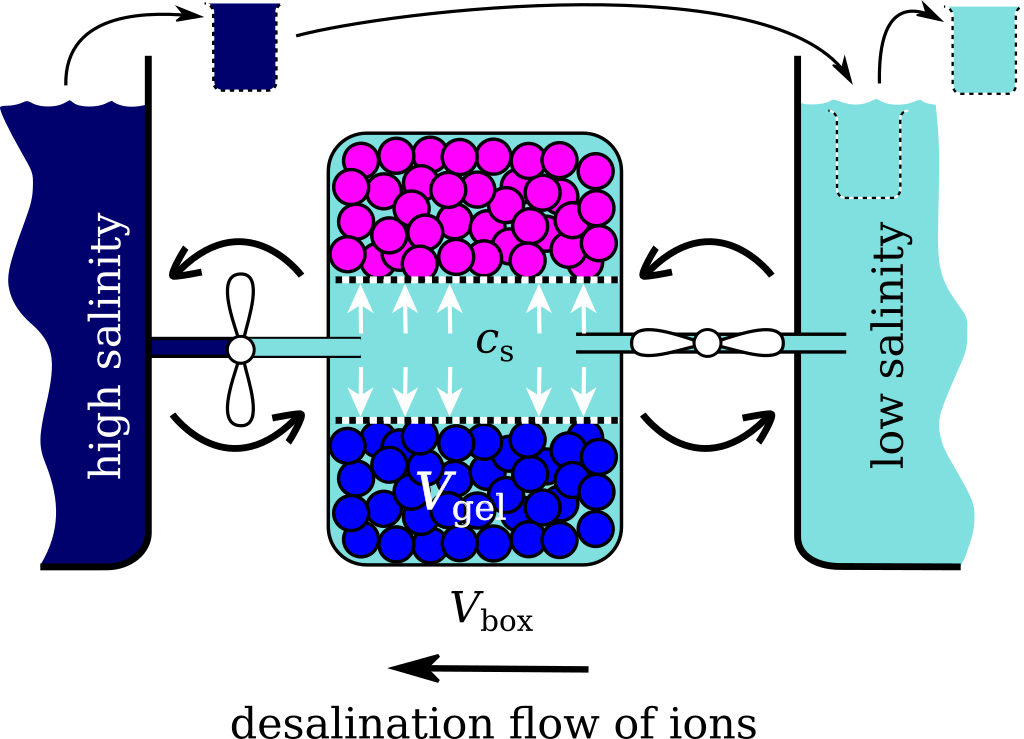 |
Scheme of the desalination machine: the desalination box of volume V_box contains a gel of volume V_gel which is separated by a sieve from the outer solution volume V_out =V_box- V_gel. The box is connected to two big tanks with high and low salinity by two taps which can be opened and closed as desired. The chain of buckets expresses the fresh water consumption followed by refilling the low-salinity reservoir by salt water. Helvrud [CC BY-SA (https://creativecommons.org/licenses/by-sa/4.0)]
References:
Coutts, M.V. (2019). “Desalinización del agua: ¿se podría convertir en una solución para enfrentar la escasez en Chile?”. En El Definido. Recuperado de https://www.eldefinido.cl/actualidad/pais/9844/Desalinizacion-del-agua-se-podria-convertir-en-una-solucion-para-enfrentar-la-escasez-en-Chile/
Econet. (2017). Métodos de desalinización del agua de mar. Recuperado de https://www.econetdesatascos.com/es/blog/metodos-desalinizacion-agua-de-mar/211
Martins, A. (2017). “¿Puede la desalinización ser la solución para la crisis mundial del agua?”. En BBC Mundo. Recuperado de https://www.bbc.com/mundo/noticias-39332148
How to cite this article:
Nocetti, F.A. (2020). "The desalination of seawater". In NabbuBlog. Retrieved from http://nabbublog.blogspot.com/2020/01/the-desalination-of-seawater.html