
Some facts about the piano
Some facts about the piano
- Record of human voices on the piano and other things
Frequencies of Piano notes in the central scale
Do (C) 262 [Hz]
Re (D) 294 [Hz]
Mi (E) 330 [Hz]
Fa (F) 349 [Hz]
Sol (G) 392 [Hz]
La (A) 440 [Hz]
Si (B) 494 [Hz]
Record of human voices on the piano (Instituto Schiller, 1988).
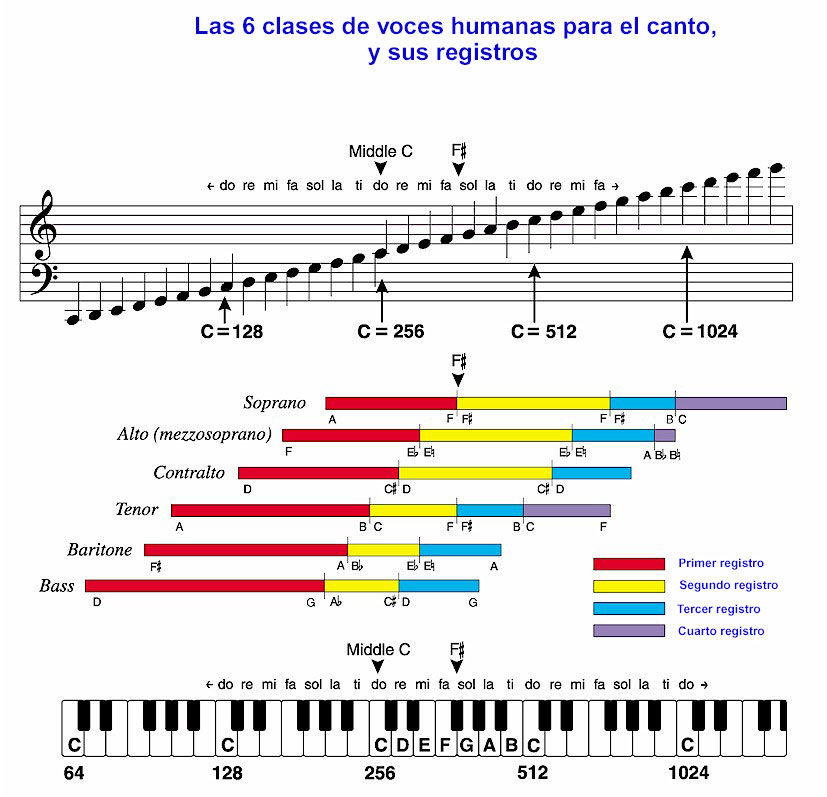 |
Instituto Schiller
Hammers and Dampers
- They have to be hard woods
Nocetti, F.A. (2014). "Some facts about the piano". In NabbuBlog. Retrieved from http://nabbublog.blogspot.com/2014/11/some-facts-about-piano.html
- Generally of latifoliate species
 |
Gramscimania
- The lower the frequency, the greater the amount of harmonics perceptible by the human ear
- The higher frequency, the lower the amount of harmonics perceptible by the human ear
- The pins go clockwise because they are fastened with nuts
- The higher frequency, the lower the amount of harmonics perceptible by the human ear
- The pins go clockwise because they are fastened with nuts
Diameter of the strings:
- Serious strings 1/30 [inch]
- Sharp Strings 1/3 [inch]
- Thick strings vibrate more slowly than thin strings
- The twisting allows to reduce the thickness of the rope
- Copper has an impedance superior to other metals
- Serious strings 1/30 [inch]
- Sharp Strings 1/3 [inch]
- Thick strings vibrate more slowly than thin strings
- The twisting allows to reduce the thickness of the rope
- Copper has an impedance superior to other metals
References:
Instituto Schiller. (1988). Volver a la afinación antigua. Recuperado de http://archive.schillerinstitute.com/newspanish/InstitutoSchiller/Arte/afinacionantigua.html
Michel, A. (2011). "Datos sobre el piano". En Gramscimania. Recuperado de http://www.gramscimania.info.ve/2011/01/datos-sobre-el-piano.html
How to cite this article:
Nocetti, F.A. (2014). "Some facts about the piano". In NabbuBlog. Retrieved from http://nabbublog.blogspot.com/2014/11/some-facts-about-piano.html